
Shifting Your Tone: Voice 2
Writing experiment


I’m running my Voice masterclass on Zoom on 10 February, where something we’ll discuss is the importance of achieving a particular tone in writing.
Some definitions
Voice and tone go together in discussions of craft, but there is a distinction that’s worth grasping.
I think of voice as the vehicle of writing and speaking. It’s what carries the words. Voice starts somewhere inside, down in my belly, then rises up through the lungs and the throat, carried on the breath; this might be invisible, but it makes voice embodied, a concrete, physical thing. In my French class I was always intrigued that the stick man we labelled with captions for le bras and la jambe also carried one for la voix.
Voice is also a way of describing the distinct prose style of a piece of writing, or the personal mode of expression of a writer.
Tone, on the other hand, is a particular quality or subset of voice. It is one of the tools with which a writer can convey emotion.
Tone can also reveal the prevailing attitude of a speaker or narrator - and ultimately the writer - and it can shift through a piece of writing, at times conveying lightness, other times creating tension or darkness.
I also like to think about a specific narrative tone: the specific voice and style that tells a story.
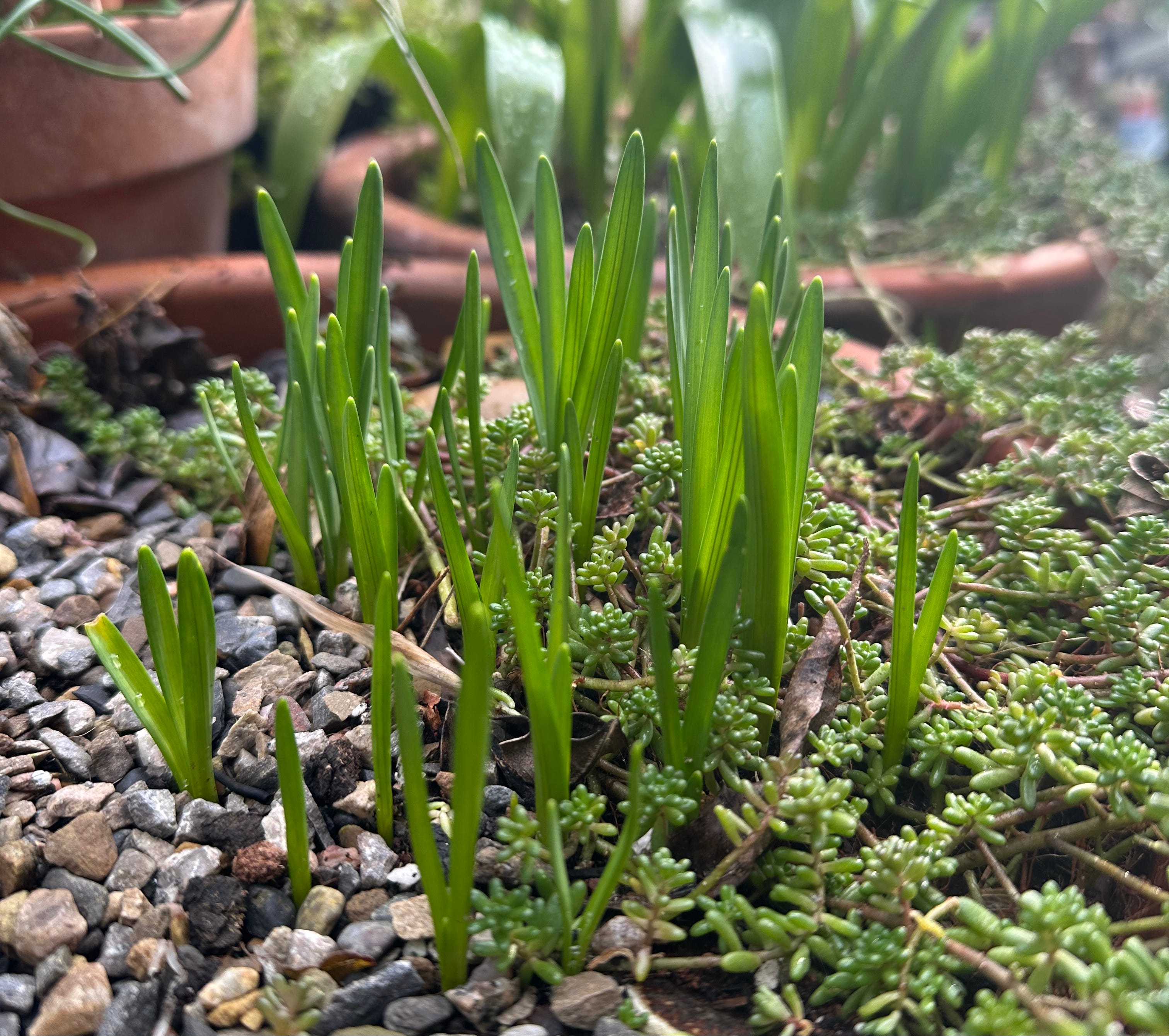
It is helpful to consider the use of tone in other fields too: music (sharp, harmonious), anatomy (muscular, flabby), painting and photography (dark, light). The sunny tone in the photo above, taken yesterday morning, creates a more cheerful impression than the gloomier one in the picture of the same daffodils below, which I took a few days before.
Perhaps these analogies can affect how you think about your own writing: does something strike too sharp a note? Do you have too much fat? Do you need to introduce more shade or light? What emotional impression might you want to make?
In writing, tone can be expressed or controlled in a variety of ways, such as:
word choices and vocabulary
punctuation
sentence length
pacing
the level of description
the use of particular parts of speech
a particular mood of address or stance
through content, e.g., consider how violent gestures or actions can swiftly alter the tone of a piece of writing
Let’s consider a few examples.
A harsh tone
I was thinking it was hard to attribute a particular emotion to the speaker in Jamaica Kincaid’s ‘Girl’. But then I realised that is the point: this piece has a forbidding, almost cold tone. It is controlling, domineering, and most definitely superior:
Wash the white clothes on Monday and put them on the stone heap; wash the color clothes on Tuesday and put them on the clothesline to dry; don’t walk bare-head in the hot sun; cook pumpkin fritters in very hot sweet oil; soak your little cloths right after you take them off …
The choice of the list as a form is in itself relevant: using the imperative mood, the speaker is handing out a mostly uninterruptible and uninterrupted list of orders and instructions that reinforces her authority.
This piece brings up something else. When using tone in a piece of writing, writers might have to decide if they are going to be literal or ironic: should the voice be taken at face value, or should the reader infer meaning from what can be read beneath or around the text?
In ‘Girl’ we have a first-person speaker, but we don’t need to identify Kincaid with that fierce mother. Instead, she is making a statement through a character’s words, and we come away with Kincaid’s observations on, among other things, the nature of power in that sort of mother-daughter relationship. It’s useful to consider another term here: persona. Kincaid has created a character with a particular persona, or mask, to convey the things she needs to say.
An ironic tone
Lorrie Moore’s How To Become A Writer, Or Have I Earned This Cliché? has a tartly ironic tone:
In your high school English class look at Mr. Killian's face. Decide faces are important. Write a villanelle about pores. Struggle. Write a sonnet. Count the syllables: 9, 10, 11, 13. Decide to experiment with fiction.
I adore the list as form as it’s so natural and easy, and the list-making here is rich in concrete details that are wry, revealing, and relatable. I often direct writers to create versions based on their own histories in writing.
Irony relies on incongruities: contradictions, exaggeration, understatement or the unsaid, superior knowledge, situational discrepancies. The supreme irony of Moore’s piece, of course, is that all these disastrous attempts at becoming a writer are what eventually turn the writer into a writer.
A sarcastic tone
Taking irony further, sarcasm can be a very sharp tool for writers, signifying an opposite meaning while adding a layer of scorn or mockery.
Another piece that puts a particularly sarcastic and pointed tone into a list format is ‘How To Write About Africa’ by Binyavanga Wainaina:
Among your characters you must always include The Starving African, who wanders the refugee camp nearly naked, and waits for the benevolence of the West. Her children have flies on their eyelids and pot bellies, and her breasts are flat and empty. She must look utterly helpless. She can have no past, no history; such diversions ruin the dramatic moment.
Its title should really be ‘How Not To Write About Africa’, shouldn’t it?! But then we’d have a scolding tone, and that’s no fun, is it. Plus it’s more likely to be ignored.
A risk with sarcasm is that sometimes it fails to land. I once used this piece in a college class, and some students were bothered by what the writer had to say as they interpreted it literally - which perhaps presents another irony.
Warmer and softer tones
In Annie Proulx’s Brokeback Mountain the tone occasionally shifts from the depiction of gritty hardships and earthly lusts to the deeper affections its characters long for:
What Jack remembered and craved in a way he could neither help nor understand was the time that distant summer on Brokeback when Ennis had come up behind him and pulled him close, the silent embrace satisfying some shared and sexless hunger.
At such points the sentences grow longer and more lyrical, slowing us down to enjoy soft-focused recollections of intimate moments; memories often invite a warmer tone. I Remember pieces often shift into the softer tone of nostalgia.
I’m also thinking of the warm tone created in, say, the novels of David Nicholls, with their generous portraits of characters’ emotional dramas, or the light and frothy tone achieved in the settings and situations of Armistead Maupin’s Tales of the City.
And there are many other ways of looking at tone: scrappy, messy, inviting, direct.
An exercise
To practise tone in your writing:
Write a piece based on a list in which a speaker directly addresses another person. Like Kincaid, instruct them in what to do, or perhaps like Wainaina or Moore show them how to do something specific while giving your instructions something of an ironic or sarcastic edge. Perhaps choose a topic you feel strongly about, and perhaps you could channel what you have to say through a persona. Or try a version of How To Become A Writer based on your own history.
Give that list a particular emotional quality. A list does not have to be a bossy form. It could be cheerleading, cajoling, sarcastic, angry, bitter. As with any form, work and play within its limits, and own whatever it is.
Be aware of your own use of language: word choices, punctuation, sentence lengths, pacing, description, and parts of speech.
As ever, specific and concrete usually win out over abstract and vague. In the examples linked above, note how tangible details bring their writers’ worlds and messages to life: salt-fish, sewing on a button, the slut; majoring in child psychology, the Names For Baby encyclopedia; monkey-brain, a nightclub called Tropicana.
Above all, be passionate about what’s said. Know the things that you as a writer need to say, and then in service of that cause know how your voice (or persona) can say things to convey that message effectively, either directly or indirectly.
My Voice masterclass runs on Zoom on 10 February at 7-8.30pm London time. All welcome! It comes with preparatory reading and writing experiments, and after the class you’ll also get a workbook packed with notes and resources.
An earlier version of this post first appeared on my blog.
I really like the exploration of tone's various iterations in our language here: "It is helpful to consider the use of tone in other fields too: music (high-pitched, harmonious), anatomy (muscular, flabby), painting and photography (dark, light)."
I also love the Kincaid analysis and this: “the speaker is handing out a mostly uninterruptible and uninterrupted list of orders and instructions that reinforces her authority.” It's such a brilliant way of interpreting that piece.
I also really enjoyed the irony and sarcasm examples and I completely agree that the latter in particularly doesn’t always land. It’s tricky but perhaps worth the risk?
You really are the best, Andrew! After 6 weeks in Australia, I am back in UK. Big writing month ahead for me on both my Siren book and on my fictionalised memoir as well. This post is going to help me, not only with my own work but also as a memoir editor...I am passing it onto my clients :)